

The Setup
High-stakes global launches — where the gap between vision and execution is widest.

The brief arrives with all the hallmarks of a high-stakes global launch. A premium brand. An ambitious market entry. A timeline that leaves no room for error. The leadership team has assembled a roster of specialists — creative directors, regional marketing leads, digital strategists, PR consultants, logistics coordinators.
The strategy is compelling. The creative is strong. The budget is substantial.
And yet, six weeks in, the project is stalled. Not because of a lack of talent or resources. But because no one on the team can translate the strategic plan and the operational reality into execution across multiple markets, regulatory settings, and cultural settings simultaneously.
This is the dependency trap. And it's more common than most leaders want to admit.
The Common Misconception
"More hands will solve it." — The assumption that creates the problem.

When global projects stall, the instinctive response is to add more people. More regional specialists. More coordination layers. More oversight.
The logic seems sound: if the problem is complexity, the solution is more capacity. If the problem is local knowledge gaps, the solution is more local experts. If the problem is execution speed, the solution is more hands.
But this logic misunderstands the nature of the problem.
The bottleneck in most high-stakes global launches isn't a lack of expertise. It's a lack of integration. The ability to hold the full picture — strategic intent, operational constraints, cultural nuance, regulatory reality — and translate it into action without losing fidelity at every handoff.
Adding more specialists doesn't solve the consolidation problem. It deepens it.
Where It Actually Breaks
The mechanics of why global launches stall.

The failure patterns are predictable once you know what to look for:
Dependency bloat
Every specialist creates a new dependency. Every dependency creates a new coordination requirement. Every coordination requirement creates a new delay point. The project becomes a network of interdependencies that moves at the speed of its slowest node.1
Translation loss
Strategic intent degrades with every handoff. By the time the creative brief reaches the regional execution team, the original intent has been filtered through three layers of interpretation. What arrives is a diluted version of what was intended.
Accountability gaps
When responsibility is distributed across too many people, no one owns the full outcome. Everyone owns a piece. No one owns the result. When things go wrong — and in global launches, they always do — no one can course-correct across the full scope.
Administrative paralysis
Cross-border execution involves a level of administrative complexity that most creative and strategic teams are simply not equipped to navigate. Regulatory requirements, local vendor relationships, import logistics, payment structures — these aren't details. They're the difference between a launch that happens and one that doesn't.
The Alternative Model
Solo capability — the ability to bridge vision and execution alone.

The antidote to dependency bloat isn't a better project management system or a more detailed RACI matrix. It's a different kind of person.
A "solo-capable" lead — someone who can operate across the full spectrum of a global launch without requiring a specialist for every function. Not a generalist in the pejorative sense. An integration specialist.
This person can hold the strategic vision and translate it into operational reality. They can navigate the administrative complexity of cross-border execution without losing the creative intent. They can manage vendor relationships, regulatory requirements, and cultural features while keeping the project moving.
Three capabilities define this person:
Strategic fluency
They understand the "why" behind the brief. They can preserve brand intent without losing it in the operational noise.
Operational depth
They understand the "how" of cross-border execution. Not just in theory, but in practice. They've navigated the administrative realities that kill most global launches.
Execution velocity
They can move. Not just plan. Not just coordinate. Actually move — making decisions, resolving blockers, and driving progress without waiting for alignment meetings.
The Data
What the numbers say about solo capability versus team-dependent execution.

The performance differential between solo-capable execution and team-dependent execution in high-stakes global launches is significant — and consistently underestimated.2
Projects led by a solo-capable lead with a lean support structure regularly outperform projects led by large specialist teams on three dimensions:3
Speed
Solo-capable execution eliminates the coordination overhead that accounts for 30–40% of project schedules in team-dependent models.4 Decisions happen faster. Blockers are resolved faster. The project moves faster.
Budget efficiency
The cost of coordination — meetings, alignment sessions, rework caused by translation loss — is rarely captured in project budgets.5 In practice, it accounts for 20–30% of total project spend.6 Solo-capable execution eliminates most of this overhead.
Outcome fidelity
The strategic intent that reaches execution is closer to the original brief when fewer handoffs occur. The creative vision that reaches the market is closer to what was intended.
These aren't marginal improvements. They're structural advantages that compound across the lifecycle of a global launch.
Three Questions for Leaders
Before your next global launch, ask yourself these.

Before you staff your next high-stakes global launch, sit with these three questions:
Is there someone on this project who can independently drive from strategic brief to market execution?
If not, you have an integration problem. Adding more specialists won't solve it — it will deepen it. The question isn't "do we have enough expertise?" It's "do we have someone who can integrate it?"
How many people does a decision need to pass through before it becomes action?
In most global launches, the answer is four to six.7 Every additional layer adds delay and translation loss. The goal isn't zero layers — it's the minimum viable number. If the answer is more than two, you have a structural problem.
Is your project lead coordinating — or actually executing?
Coordination is necessary. But it's not sufficient. A project lead who can only coordinate is a bottleneck, not an accelerator. The question is whether they can also execute — make decisions, resolve blockers, and drive progress without waiting for consensus.
A Note on Nuance
Solo capability is not the same as solo execution.
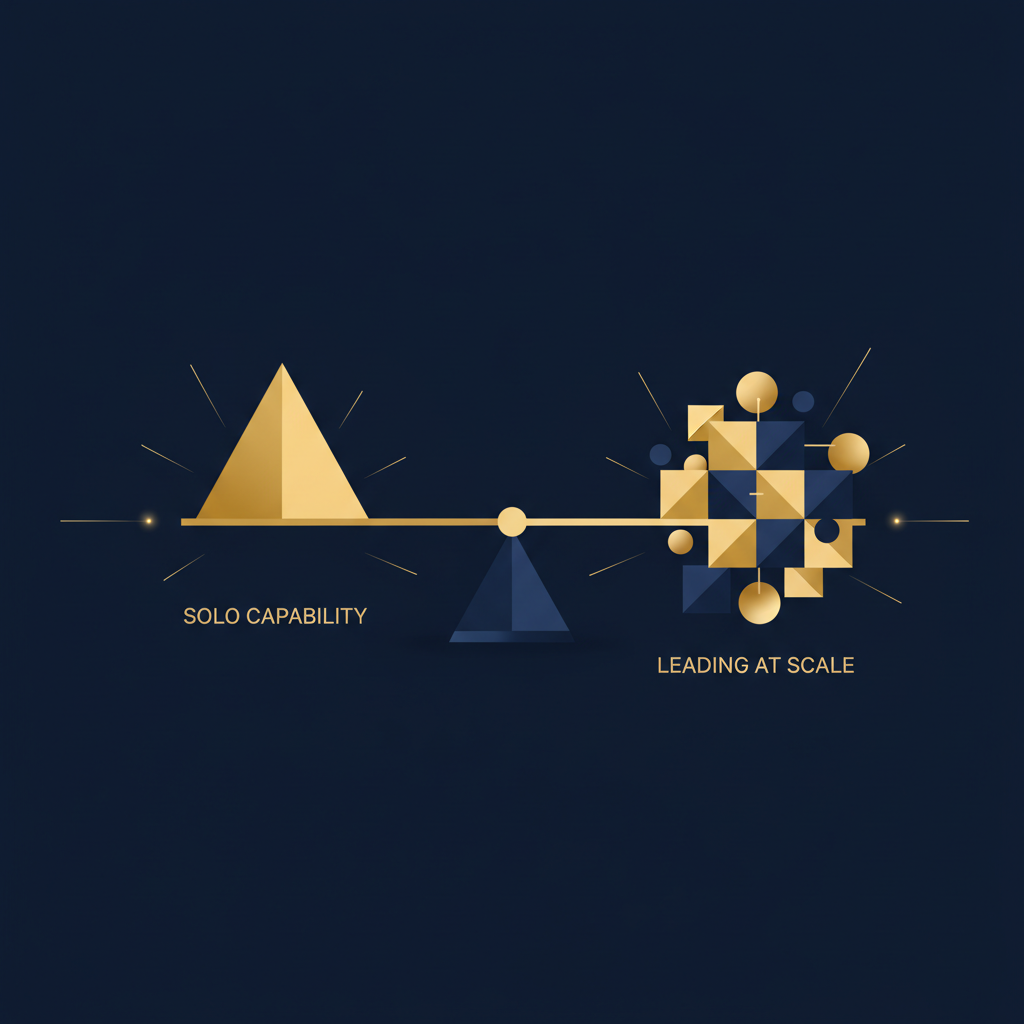
It's worth being precise about what "solo capability" means — and what it doesn't.
Solo capability is not the same as solo execution. A solo-capable lead doesn't do everything alone. They lead a lean team of specialists who execute within their domains. The difference is that the solo-capable lead can operate within those domains when needed — not just coordinate between them.
This distinction matters because it changes the staffing model. Instead of assembling a large team of specialists who each own a narrow function, you build a lean team around a solo-capable lead who can bridge the gaps between functions.
The result is a team that's smaller, faster, and more aligned — not because it has fewer people, but because it has fewer dependencies.
Solo capability also doesn't mean ignoring scale. Some projects genuinely require large teams. The question is whether the team is structured around integration or around specialization. The former scales. The latter stalls.
Closing Reflection
The capability gap that most global launches don't know they have.

The most common failure mode in high-stakes global launches isn't a lack of creative vision or strategic ambition. It's a capability gap that most leadership teams don't know they have.
The gap between strategy and execution. Between vision and operational reality. Between what's intended and what actually reaches the market.
This gap isn't filled by adding more specialists. It's filled by finding — or developing — people who can bridge it. People who can hold the full picture, navigate the administrative complexity, and drive from concept to completion without losing the thread.
Before your next global launch, ask a different question. Not "do we have enough people?" but "do we have the right person?"
The answer to that question is the difference between a launch that delivers and one that produces beautiful documentation of why it didn't.
"The gap between strategy and execution isn't filled by adding more people.
It's filled by finding the right one."
Professional Opinion & IP Notice
This article is original intellectual property drawn from direct professional experience, independent field observation, and proprietary analysis. The views expressed are solely my own and do not represent any employer, client, or affiliated organisation. No part of this work — including its frameworks, arguments, or structure — may be reproduced, forwarded, quoted at length, or used in any form without explicit written authorisation. If you are interested in referencing or republishing this content, please get in touch.